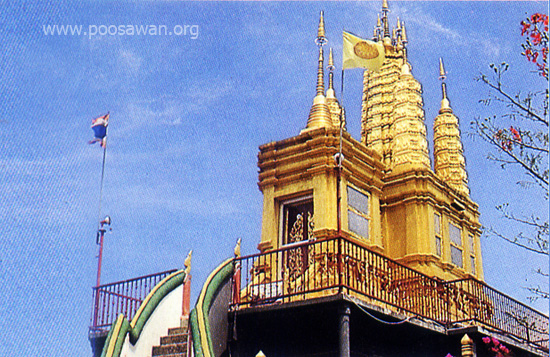
THE RELIGIOUS LAND HOOPPHA SAWAN
The Religious Land Hooppha Sawan is situated in the mountain range named “Tham Phra” (locally named “Suae-Mohb” or crouching tiger) at Donsai Sub-district, Pak Tho District, Ratchaburi Province.
This place had an important historical significance. In the third century of the Buddhist Era, King Ashoka the Great of the Indian Sub-Continent sent out several Buddhist missions to disseminate Buddhism in many lands. One Buddhist mission led by the Most Venerable Sona Mahathera and the Most Venerable Uttara Mahathera had travelled by ship to Suvarnabhumi Peninsula. That ship sank at Prachuapkhirikhan Province. The Buddhist mission continued their travel by cart and took their night stop over in a cave later named “Salika,” located at Suae Mohb mountain. The mission then climbed up its peak to have a bird’s eye view of the local community to start their preaching of Buddhism. This place was the dawn of Buddhism in Thailand. The mission later traveled to the Khoo-Bua Village some 10 kilometerss away from the Tham Phra site and started propagating Buddhism.
On one occasion, when Luang Vichit Vatakarn, the then Director-General of the Department of Fine Arts realized the importance of this place, he officially declared on February 25th, 1935 , the Tham Phra mountain range a registered archaeological site of the Ratchaburi Province.
In 1970, Dr. Suchart and one novice made a trip on foot to this mountain range to seek a suitable place to practise meditation. After surveying the area, he considered it a proper place as it enjoyed a fine view and was conducive for meditation and relaxation. With this reason, he started developing the place to be a religious centre for all religions. He then proceeded to contact leaders of other religions and erected objects of worship of Buddhism and other religions, which would pave the way to promote inter-religious brotherhood and to organize the World Eternal Peace Conference in the future.
The development and construction of the Religious Land Hooppha Sawan proceeded mindfully with the best conservation of nature. On each occasion that a ceremony was organized, the chairman of the ceremony would plant a memorable tree as well.
On each peak of the mountain range at the Religious Land Hooppha Sawan, there were important objects of worship, for example, the Peace Pagoda, a symbol of world peace; the 9-metre high Image of Lord Buddha; Hindu God Lord Ganesha; the huge Image of the Would-be Buddha Kaccayana Mahathera, built in Chinese style; the 9-metre high Statue of Lord Jesus Christ; a miniature statue of the Virgin Mary, presented by the Vatican; and the 9-metre high Image of the Would-be Buddha Avalokitesvara Bodhisattva (Kuan Yin). According to the project of promoting inter-religious brotherhood, there were plans to erect other images of all Holy Founders or symbolic structures of great religions of the world with the granted permission from their respective religious leaders.
The Holy Statue of the Most Famous Ecclesiastical Buddhist Monk and Royal Counsellor of King Rama IV and King Rama V of the Chakri Dynasty (B.E. 2331-2415/A.D. 1788-1872) known as Somdej Phra Buddhacharn (Toh) Brahma Ransi was installed in the Singh Mongkol Boon Bamrung cave.
Inside the “Salika Cave” was the Holy Statue of “Phra Bodhisattva Luang Poo Tuad (Changing Salty into Fresh Water),” the 3rd Supreme Patriarch of Ayutthaya Period. In front of the cave, the Statue of King Rama I the Great, the founder of the present Chakri Dynasty and Bangkok City was installed. He once marched his army to face his enemy and stopped at this place. Besides, there were Prasart Phra Dhatu (Pavilion), and the Chief Lord Indra Hall. There were also places for conducting rituals and ceremonies: the Jinnapooto Memorial Foundation Hall, Brahma Ransi Pavilion, and so on.
The most important building was the World Eternal Peace Conference constructed to convene the World Eternal Peace Conference.
The landscape of the Religious Land Hooppha Sawan was fully suitable for pilgrimage. All the time there were religious people who traveled there to pay homage to objects of worship. Particularly on weekends, there were many organized tour groups visiting the site. Each month about ten thousand people visited the Religious Land.
At the beginning of his work to develop the Religious Land Hooppha Sawan, Dr.Suchart had to fight against influential groups who with commercial purpose in mind attempted to commence rock-blasting activities of the Tham Phra mountain range, a protected national archaeological site.
To achieve the ten-point objectives of Samnak Poo Sawan, the following offices were set up at the Religious Land Hooppha Sawan:
- Jinnapooto Memorial Foundation
- Office of the World Peace Envoy
- International Federation of Religions
- Inter-religious Brotherhood Promotion Centre
- Vegetarianism Promotion Centre
- World Eternal Peace Conference Project
- Youth Morality Training Centre
- International Meditation Centre
- Psychic Ailment Treatment Centre
- Bodhisattva Housing Project
All these tasks were under the responsibility of Dr. Suchart Kosolkitiwong.
The Religious Land Hooppha Sawan organized activities according to periods of
traditional festivals for merit making, and arranged festivals on significant occasions relating to the nation, the religion, and the monarchy. Some important ceremonies were organized here. These included the Consecration Ceremony of the Buddha Amulets containing holy soils from 9 countries (for unity), the Foundation Stone Laying Ceremony of the Peace Pagoda, the Foundation Stone Laying Ceremony of the World Eternal Peace Conference Hall, etc. In such ceremonies the participants were ambassadors, representatives from diplomatic corps, as well as more than ten thousand religious people.
At the Religious Land in the night of the 19th of every month, religious followers from all parts of Thailand would gather around the Peace Pagoda to practise religious activities and listen to Dhamma speeches of Dr. Suchart, who was also often referred to as the Peace Envoy. Those speeches helped them learn about the situation of the country and the world. They also learned about using meditation power to halt military forces. After the speech, they all chanted and prayed in unison to the Divine Power for the safety and peace of the nation and for all mankind. They then spent the rest of the night in meditation on the 12-acre flat area on the mountain range till 04.00 hrs. when they once again chanted together before departing for home. This activity was initiated in 1977 and lasted until March 1991.
Dr. Suchart also instructed members of Samnak Poo Sawan and the Religious Land Hooppha Sawan in the various provinces to arrange regular chanting, praying and meditating sessions for the safety and peace of the nation and the entire world.
In June 1981, Dr. Suchart and his Executive Committee had drafted “Rules of the Religious Land Hooppha Sawan” for the purpose of making the Religious Land a supramundane land.
To keep up with world events, the Religious Land Hooppha Sawan adopted the adjusted ten-point objectives to serve the new society as guidelines for performing its works as follows:
- Help relieve the physical and spiritual sufferings of all mankind;
- Help lessen defilements in the minds of selfish human beings;
- Help abolish dogmatic beliefs and ignorance in the minds of men;
- Help uphold social justice in the world;
- Help protect the existence of peace and the monarchical institutions;
- Help promote the progress of religions by all available means;
- Help support all technical experts who have genuine knowledge and who are
truly committed to working for the prosperity of society and the country;
- Help cooperate with all well-wishers for the good of our nation;
- Help bring ethical morality to the minds of the younger generations;
- Help confirm the belief in “Life after death” so that people will avoid committing sinful acts.
Dr. Suchart has undertook to work in line with these objectives for the New Society and at the same time to work also for world peace.
To carry out all projects for world peace, he promoted activities to instill basic ethical morality in the mind of the younger generations: to become peace lovers, to realize the supreme value of life and to apply non-violence means in solving their future problems. Furthermore, he organized and directed many activities in relation to world peace promotion projects. Those included:
- The ordination of monks and novices, there were about
30 monks and novices ordained at each time.
2. The setting up of social welfare volunteer group named the ‘Lion Youth Group”
with the purpose to train them to do beneficial work for the
community and to behave themselves according to the Buddhist doctrines as
to try to get rid of the sources of all evils –greed, hatred and delusion — from
their minds.
3. The arrangements of Buddhist meditation programmes for the general public;
- The dissemination of the Buddhist ideals and morality to the public through the media of film, slides, books, newspapers, etc.
In his future programmes, he was very interested in setting up the International
Meditation Centre at Hooppha Sawan too but it was not materialized.
JINNAPOOTO MEMORIAL FOUNDATION
Dr. Suchart Kosolkitiwong and his Executive Committee had formed the Jinnapooto Memorial Foundation with the granted licence from the Department of Religious Affairs to carry out its manifested objectives. It was registered as a legal entity with the National Police Department on September 9th, 1975. Prof. Dr. Kloom Vajaropala was the first Chairman of the Foundation. Dr. Suchart Kosolkitiwong was appointed the second Chairman in 1976-1989.
According to the licence, the Jinnapooto Memorial Foundation had the following objectives:
- Propagate Buddhism.
- Research, study and propagate biographies of the Supreme Patriarch Kurupajarn Phra Bodhisattva Luang Poo Tuad (Changing Salty into Fresh Water) and Somdej Phra Buddhacharn (Toh) Brahma Ransi.
- Research, study and disseminate information on the subject of spirituality and the mind.
- Provide public services according to the resolution of the Executive Committee.
- Help promote the ten-point objectives of Samnak Poo Sawan.
- Carry out other beneficial public activities as agreed by the resolution of the Executive Committee.
- The Foundation was a non-political entity.
Dr. Suchart himself implemented the objectives of the Foundation with many
activities, for instance:
- Accepting invitations to give lecture on Dhamma at many academic institutes of
different levels and to give interviews on the subject of peace and religion in radio and television programmes.
- Visiting soldiers and policemen stationed along the remote borders to boost
their morale.
- Propagating sermons of the Great Masters of Samnak Poo Sawan
in newspapers, Dhamma publications, Dhamma cassette tapes and making slides to be used during his lecture.
– Erecting objects of worship in the Religious Land Hooppha Sawan. The most important one was the Peace Pagoda (Santi Chedi) which was a miniature of Nibbana Chedi in heaven. It had ten intricate spires representing the ten virtues of Lord Buddha. Inside each spire enshrined the Holy Relics of Lord Buddha, Arahants and Bodhisattvas presented by Sri Lanka, Nepal and also Thailand. There were also Holy Soils from sacred places of various countries and Holy Soils from the Four Holy Places of Buddhism in the Jambu Continent (India) which were enshrined at the base of the Pagoda. The most beautifully and elaborately designed image of Lord Buddha was inside the Peace Pagoda, opened for public worship only on the 19th of every month and on special occasions. In the pagoda, there was a stone inscription on the wall, telling about the importance of the Peace Pagoda.
- Providing religious functions on significant days of Buddhism, celebrations of
festival days, and particularly on Visakha Puja Day, the ceremony of Paying Homage to Great Masters of Samnak Poo Sawan would be organized.
- Forming the International Federation of Religions.
- Setting up the Inter-religious Brotherhood Promotion Centre.
- Doing research, studying and propagating biographies of the Supreme Patriarch
Kurupajarn Phra Bodhisattva Luang Poo Tuad (Changing Salty into Fresh Water) and Somdej Phra Buddhacharn (Toh) Brahma Ransi.
- Disseminating the facts on spirituality and mind through lectures, books
and audio-visual aids.
- Contributing money and humanitarian aids to help people who were suffered
from calamity.
- Donating money to construct lodgings at Ananda Kuti, Nepal, for pilgrims who
traveled to pay homage to the Holy Places of Buddhism.
- Helping in the restoration of school buildings, and distributing clothes, stationary
and medicines to needy pupils and students.
- Supporting the ordination of novices, monks and as well as lay-people who were
determined to practise meditation and mind purification.
- Offering scholarships to assist good but needy students and pupils. In 1976-
1977, he offered a total of 26 scholarships to undergraduates in universities and in secondary schools both in Bangkok and in many provinces. After presenting scholarships, he gave a speech on moral conduct, and told how meditation could benefit both in their studies and examination.