INTERNATIONAL FEDERATION OF RELIGIONS
When the world situation became tense with the possible outbreak of World War III, Dr. Suchart considered that it was high time to work fully for world peace. He saw the need to have a particular centre devoted for world peace. So he suggested to the Executive Committee’s Buddhist members of Samnak Poo Sawan and the Religious Land Hooppha Sawan to form the International Federation of Religions (IFR). The IFR was registered with the Government of Thailand on 18th November 1975 with its headquarters at the No. 59, Soi 31 (Swasdi), Sukhumvit Road, Klongton Sub-district, Pra Khanong District, Bangkok. Maj. General Prakarn Bhuvanartnurak was the President of the Federation.
Objectives of the IFR
According to Article III of its Constitution, the IFR has the following objectives:-
- To help promote mutual practice amongst members having strict observance of the teachings of the great founders of religions;
- To help strengthen unity, solidarity, and brotherhood amongst members;
- To help propagate the sublime doctrines of religion;
- To help render cooperation in the work of social, educational, cultural, and other humanitarian services;
- To help promote a lasting peace and harmony for all mankind, and collaborate with other organizations working towards the same goal;
- To help promote unification amongst men with an idea of creating world unity;
- To help eliminate controversial disagreement on religions and political doctrines in order to raise the spirit of religious brotherhood and equality for all mankind;
- To help promote human rights in their work that will not cause harm and
difficulties to mankind;
- To help search for ways and means to work together on the World Eternal Peace Conference.
In 1977, Dr. Suchart Kosolkitiwong was elected President and served in this position up until 1989. When the Court of Justice confiscated the property of Jinnapooto Memorial Foundation, the Federation stopped functioning and was closed.
Under his direction, he made strenuous efforts to materialize his peace ideals, expanding all-out nationwide activities especially of the branch offices of the International Federation of Religions and appealing the ideal to people of all walks of life. There were IFR’s branches in 52 provinces.
The IFR began to work on its inter-religious brotherhood promotion.
Later, he moved the headquarters of the Jinnapooto Memorial Foundation and the International Federation of Religions to be permanently sited at the Religious Land Hooppha Sawan, the proposed venue for the World Eternal Peace Conference. From this place his Religious Mission for Peace had been sent to many countries around the world, to strengthen religious brotherhood and peace cooperation among those prominent religious leaders and peace activists, and introduce them to his peace ideal especially on solidifying religious and peace forces against the war mongers. He also proposed to them his plan to hold the international meeting to prevent war, the World Eternal Peace Conference scheduled for 1982 at the Religious Land Hooppha Sawan.
INTER-RELIGIOUS BROTHERHOOD – THE WAY TO PEACE
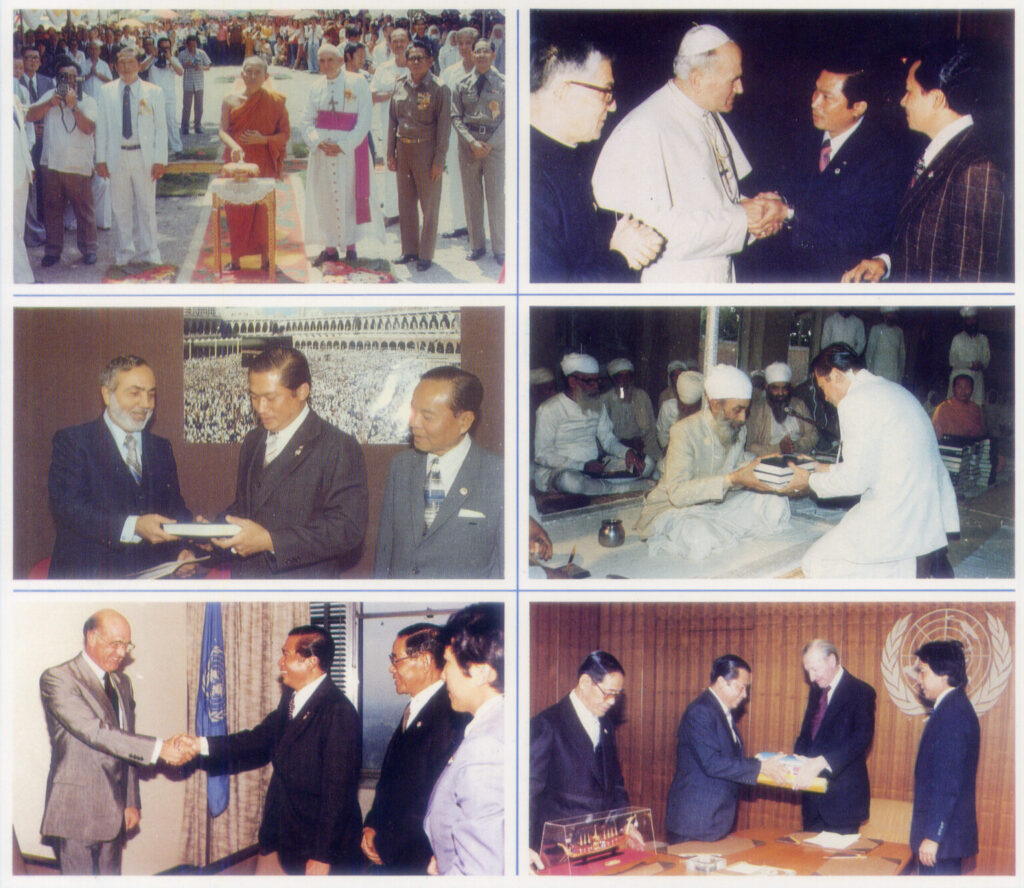
To publicize to the general public the achievement made by the IFR’s Religious Mission for Peace in promoting inter-religious brotherhood and world peace cooperation, the IFR organized the Exhibition of the Religious Mission for Peace on various occasions:
October 19th, 1977:
An Exhibition of Christianity – Buddhism Brotherhood Promotion
December 25th, 1977:
The Anointing and Foundation Stone Laying Ceremony of the 9-metre High Statue of Lord Jesus Christ, the construction of which was completed in 1979.
February 19th, 1978:
An Exhibition of Buddhism-Sikhism Brotherhood Promotion.
October 19th, 1978:
A Foundation Stone Laying Ceremony of the World Eternal Peace Conference Hall with the participation of representatives of 5 major religions including diplomatic corps members from 19 countries stationed in Bangkok.
October 6th, 1979:
Bishop Peitro Carretto, President of the Episcopal Commission on Dialogue and Ecumenism in Thailand conferred the image of Virgin Mary brought from the Vatican City to Dr. Suchart Kosolkitiwong to be sited along with the Statue of Lord Jesus Christ on a mountain peak at the Religious Land Hooppha Sawan.
October 19th, 1980:
A Praying Ceremony for World Peace was held along with 4 other functions:
- An Anointing and Foundation Stone Laying Ceremony of the 9-metre high Image of the Would-be Buddha Avalokitesvara Bodhisattva (Kuan Yin).
- An Exhibition of the Works on the Inter-religious Brotherhood Promotion by the 3rd-6th Missions.
- The Fourth Year Celebration of the Peace Pagoda with its renovation in golden leaves. (the former one was in white)
- A Praying Ceremony for World Peace.
The Ceremony was presided over by the Most Rev. Peitro Carretto, President of the
Episcopal Commission on Dialogue and Ecumenism in Thailand with H.H. Sri Satguru Jagjit Singh Ji Maharaj, the Supreme Spiritual Leader of Namdhari Sikhs as Chairman of the Opening Ceremony. This ceremony was held in support of the achieved efforts toward world peace and lasted 10 days.
April 13th, 1981:
An Exhibition of the Works on the Inter-Religious Brotherhood Promotion by the 7th-9th Missions.
SIGNIFICANT MEETINGS ON PEACE COOPERATION
In 1977-1991, since worldwide prominent religious and peace leaders (including diplomatic corps) were greatly interested in the IFR’s activities for world peace and its plan to hold the World Eternal Peace Conference, they paid a visit to the Headquarters of IFR, located at the Religious Land Hooppha Sawan, Ratchaburi Province, Thailand. They had met with Dr. Suchart Kosolkitiwong, President and with some senior members of IFR’s Executive Committee to exchange views on their creative peace dialogue and strengthen their concrete peace cooperation plan to achieve world peace. This could be summarized as follows;
February 24th, 1978:
Meeting with the 15th Supreme Spiritual Leader of Namdhari Sikhism H.H. Sri Satguru Jagjit Singh Ji Maharaj.
May 11th, 1978:
Meeting with senior members of the Executive Committee of the Asian Conference on Religion and Peace (ACRP). In this great meeting, the Most Rev. Nikkyo Niwano, President of Rissho Kosei-kai and President of ACRP kindly participated and delivered a valuable speech to promote the inter-religious cooperation and also world peace.
January 28th, 1979:
Meeting with H.E. Mr. Boguslaw Zarkzewski, the Polish Ambassador to Thailand.
May 14th, 1979:
Meeting with H.E. Dr. Kurt Waldheim, Secretary General of the United Nations on the occasion of his visit to Thailand.
May 16th, 1979:
Meeting with H.E. Mr. Iouri I. Kouznetsov, the Ambassador of the USSR to Thailand.
December 16th, 1979:
Meeting with delegations from the Council for Religious Affairs of the USSR Council of Ministers; the Asian Buddhist Conference for Peace of Mongolia; and Representatives of the World Fellowship of Buddhists/Sri Lanka Branch.
December 30th, 1979:
Meeting with Dr. Homer A. Jack, Secretary General of the World Conference on Religion and Peace (WCRP).
January 27th, 1980:
Meeting with H.E. Sri Maharaj Bir Singh Ji, the Heir Brother of H.H. Sri Satguru Jagjit Singh Ji Maharaj, the Namdhari Sikh Supreme Spiritual Leader, India.
February 25th, 1980:
Meeting with Mr. Karikar Vaitha,General Secretary and Director of the Universal Love and Brotherhood Association (ULBA), Indian Office.
March 25th, 1980:
Meeting with H.E. Mr. K.L. Dalal, the Ambassador of India to Thailand.
July 6th, 1980:
Meeting with H.E. Mr. Iouri I. Kouznetsov, the Ambassador of the USSR to Thailand.
August 10th, 1980:
Meeting with Mr. Ikuo Harada, Director of International Department of ULBA Headquarters in Kameoka, Japan.
August 24th, 1980:
Meeting with members of the World Fellowship of Buddhist Youth (WFBY), Japan.
September 14th, 1980:
Meeting with H.E. Mr. Mordechai Lador, the Ambassador of Israel to Thailand and H.E. Mr. Mohsen Fahmy, the Ambassador of Egypt to Thailand.
September 17th, 1980:
Meeting with Mr. Wang Chih-hsi, First Secretary of the Embassy of the People’s Republic of China to Thailand.
September 28th, 1980:
Meeting with Mr. Chura Bahadur Hamal, the Charge d’Affairs of Nepal to Thailand.
Janaury 31st, 1981:
Meeting with Mr. Shih-ching Hsu, Chief of the United Nations Information Service, UN Economic and Social Commission for Asia and the Pacific (ESCAP), Bangkok.
February 14th, 1981:
Meeting with Mr. Philip Isely, Secretary General of the World
Constitution and Parliament Association (WCPA), U.S.A.
February 16th, 1981:
Meeting with Mr. Reinhart Ruge, Co-President of WCPA (Mexico) and Dr. T.P. Amerasinghe, President of Sri Lanka Branch WCPA and President of Sri Lanka Branch ULBA.
March 1st, 1981:
Meeting with the Most Venerable Amarit Nanda Mahathera, Sangha Head of Nepal.
March 30th, 1981:
Meeting with Mr. N. B. Bajracharya, Chairman of Vajrayana Buddhist Sangha and President of Nepal Branch ULBA accompanied by Swami Iswarananda, Head of Geeta Mandir, Nepal and Mr. S. Viswariah, Editor of “World State,” India.
June 7th, 1981:
Meeting with the members of the Trade Representative of the Democratic People’s Republic of Korea to Thailand.
June 26th, 1981:
Meeting with Mr. Puran Singh Azad, General Secretary of WCPA (India) and President of Indian Youth Congress together with Shri Chiman Bhai Patel, Chief Minister of Gujarat State Government (India).
July 19th, 1981:
Meeting with H.H. Sri Satguru Jagjit Singh Ji Maharaj, the Supreme Spiritual Leader of Namdhari Sikhs, India.
July 22nd, 1981:
Meeting with H.E. Mr. Khelendra Prasad Pandey, the Ambassador of Nepal to Thailand.
August 16th, 1981:
Meeting with Gen. S.S. Uban, Executive Secretary General of the ACRP and Dr. S.K. Chaturavedi, Co-Secretary General of WCRP, India.
October 29th, 1981:
Meeting with H.E. Mr. Ashok Bhalchandra Gokhale, the Ambassador of India to Thailand.
June 6th, 1987:
Meeting with Professor Dr. Sivannardh Panday, Lecturer on Philosophy of Bombay University, India.
August 1st, 1987:
Meeting with the Most Venerable Bhikkhu Dr. Amarit Nanda Mahathera, Sangha Head of Nepal.
August 30th, 1987:
Meeting with Dr. T.P. Amerasinghe, Vice-President of WCPA, Sri Lanka.
September 26th, 1987:
Meeting with Dr. Sadhanand Misra, Secretary General of the International Meeting for the Future of Humanity of Krisna Murti Association, Orissa, India.
March 2nd, 1988:
Meeting with Dr. Neville O. Matthews, Director of the Office of General Work Cooperation of the United Nations of the Seven-day Adventists Organization, U.S.A.
March 30th, 1991:
Dr. Edward C. Yang, Rector of John Dewey University of the U.S.A., travelled to present the “Honourary Medal, Summa Cum Laude” and Citation to Dr. Suchart at Samnak Poo Sawan, Bangkok.
Dr. Reinhart Ruge, President of WCPA and Dr. T.P. Amerasinghe, Vice-President of WCPA, a distinguished guest at the above ceremony, read the Citation appointing Dr. Suchart the World Peace Envoy of WCPA for the seventh time.
Besides, Dr. Suchart Kosolkitiwong was cordially invited by embassies stationed in Thailand to participate in their National Day celebrations. On those occasions, he joined in congratulating the host and exchanged views with many diplomats on the promotion of world peace and international better understanding through inter-religious brotherhood.
PEACE ENVOY
Appointed by the Spiritual World
In 1973, Dr. Suchart Kosolkitiwong was appointed the “Peace Envoy of the World of Divinity” by the Supreme Lord of the Spiritual World. After the appointment, with his high responsibility, Dr. Suchart Kosolkitiwong started working immediately for world peace in time for the current political world situation.
Appointed by World Organizations
In Dr. Suchart’s contacts with foreign countries, important international organizations and world prominent persons agreed with his idea and works. They therefore appointed him to the following positions:
The First Time: The World Constitution and Parliament Association (WCPA) held its 4th Annual Conference in New Delhi, India between 21st-24th February 1981. At this conference, a delegate presented an urgent motion for the WCPA worldwide campaign for the World Constitution to be adopted by world citizens. There had to be a person travelling to promote better understanding with the governments around the world. This delegate requested that the Conference suggest a nominee so that they would unanimously adopt the motion. No one was nominated to be elected. A senator of Bombay then proposed that the Conference establish an ad-hoc committee of 5 members comprising representatives of Sri Lanka, Mexico, India, America and Australia to choose an appropriate person for this purpose.
The Conference reconvened its meeting on February 24th, 1981 and at 16.30 hrs. Dr. T. P. Amerasinghe, Barrister and Judge of the High Court of Sri Lanka, announced to the quorum of the plenary session, “By a special resolution unanimously adopted by a Trustee, we the World Constitution and Parliament Association, in recognizing the grand work for peace he has already performed and in believing that as an Ambassador for Peace he can advance the process of obtaining ratification of the Constitution for the Federation of Earth and the call for a Provisional World Parliament to meet in 1982, are pleased to appoint Dr. Suchart Kosolkitiwong, President of the International Federation of Religions, as Peace Envoy of the Association under the Resolution passed at the New Delhi Conference of the Association held between February 21st -24th, 1981.”
The Second Time: At the First Session of the Provisional World Parliament in Brighton, England on 4th-17th September 1982, the plenary voted unanimously confirming the appointment of Dr. Suchart Kosolkitiwong as “World Peace Envoy.”
The Third Time At the Second Session of the Provisional World Parliament in New Delhi, India on March 15th-29th, 1985, the delegates carried out unanimously the motion to confirm the appointment of Dr. Suchart Kosolkitiwong to serve the special position of “World Peace Envoy.”
The Fourth Time At its meeting held at Denver Marriott West Colorado, U.S.A., from June 27th to 29th, 1986, the Executive Cabinet of the World Constitution and Parliament Association passed a special resolution to re-elect Dr. Suchart Kosolkitiwong “World Peace Envoy” for the fourth time in succession.
The Fifth Time Dr. Suchart Kosolkitiwong was appointed “World Peace Envoy” again from a unanimous decision of the 3rd Provisional World Parliament of the WCPA met at Fontainebleau Hilton Hotel in Miami, Florida, U.S.A. on 23rd of June, 1987 which Dr. Suchart Kosolkitiwong attended from 18th-28th June 1987.
The Sixth Time At the Congress of the Executive Committee of WCPA at its Headquarters, Lakewood, Colorado , U.S.A. from the 17th-19th June 1990. The Congress decided for Dr. Suchart Kosolkitiwong to continue to be the World Peace Envoy.
The Seventh Time In the ceremony of presenting the Honourary Medal “Summa Cum Laude” from Dr. Edward C. Yang, Rector of John Dewey University of the U.S.A. at Samnak Poo Sawan on the 30th of March, 1991, Dr. Reinhart Ruge, President of WCPA read the citation of the World Peace Envoy’s work and appointed him the World Peace Envoy for the seventh time. Later in May 1991 in WCPA’s assembly, there was a decision to confirm the appointment of Dr. Suchart the World Peace Envoy for another term.
After that, the Provisional World Parliament of WCPA’s assembly and every annual conference of WCPA would confirm the re-appointment of the World Peace Envoy even though he had already ordained as a Buddhist monk.
Dr. Suchart Kosolkitiwong’s appointment as “World Peace Envoy” by the world conference was due to the fact that those prominent world leaders had realized, from their meetings and conferences together with him, that he had a firm determination to invite religious, peace and political leaders from all over the world to attend the World Eternal Peace Conference to halt the imminent outbreak of World War III.
The Appointment of the Permanent World Peace Envoy
In the 6th Session of the Provisional World Parliament held at Bangkok Centre Hotel, Bangkok, Thailand on the 24th-27th of March, 2003 in the midst of the catastrophe of the world situation when the U.S.A. started to attack Iraq on the 20th of March 2003, the Office of the World Peace Envoy and the Kuan Yin Inter-religious Park jointly organized the 60th Birthday Anniversary Celebration of Ven. Ariyawanso Bhikkhu (Dr. Suchart Kosol-kitiwong) at the Kuan Yin Inter-religious Park, the headquarters of the Office of the World Peace Envoy. Among delegates of the Provisional World Parliament who joined the ceremony, there included members who had faith in Ven. Ariyawanso Bhikkhu. Dr. T.P. Amerasinghe read the citation praising Ven. Ariyawanso Bhikkhu. Dr. Reinhart Ruge and Dr. T.P. Amerasinghe signed their names on the letter appointing Ven. Ariyawanso Bhikkhu “Permanent World Peace Envoy” on 28th March 2003.
WORKS OF THE PEACE ENVOY
OF THE WORLD OF DIVINITY
When Dr. Suchart worked on behalf of Peace Envoy of the World of Divinity, he gave sermons and suggested means for solving important problems with wits and deep thoughts. He also provided for public benefit straight forward and factual comments on situations of the country and the world.
Most of his sermons iterated the teaching of each religion for believers to live together peacefully and happily. He considered that all mankind even though different in religious belief should not disunite. The World Wars had broken out twice which had made great catastrophes for mankind. If World War III broke out, it would probably eradicate all races of humanity from earth. The prevalent political world situation inclined toward the possible outbreak of World War III. It showed the fact that men were unable to achieve world peace through military-cum-political supremacy nor economic wealth. But peace would materialize through united religious forces of the whole world to prevent the outbreak of World War III. By inviting religious, political and peace leaders to attend the World Eternal Peace Conference in the atmosphere of the Religious Land, they would cooperate to seek solutions to the world problems. Dr. Suchart firmly believed that only through religious power could the outbreak of World War III be prevented.
With this opinion, he carried out the work for the inter-religious brotherhood.
Dr. Suchart was a Thai citizen who never studied English nor could he speak English. While traveling to do work which must use English, he had a personal interpreter. He fashioned a belief that:
“This work does not depend on languages but on ideas and action. Everyone can learn several languages but not everyone can learn ideas.”
Eventhough in the NGO Conference of the United Nations, he was cordially invited to speak and he spoke in the Thai language.
He had firm determination to work for peace and had courage to travel for disseminating his ideas. When some had doubts and asked questions, he would explain with reasons and gave clear answers to them.
He organized Religious Missions for Peace and traveled to meet with prominent leaders to propose ideas and principles of works for the cause of world peace.
From 1966-1976, he traveled to many provinces and countries with the purpose of promoting inter-religious brotherhood, pilgrimage and bringing holy objects, such as, holy soils, Holy Relics of Lord Buddha from different countries and also from Thailand to be enshrined in the Image of the Would-Be Buddha Phra Sri Ariya Maitreya, the Peace Pagoda, the Statue of King Rama I, the World Eternal Peace Conference Hall for the cause of true peace in the Suvarnabhumi Peninsula (South East Asia Region) and in the world. These trips were as follows:
In 1966
In April 1966, he travelled to Chiang Mai Province in Thailand to bring holy soils from the Nim Pagoda, the Tab-Tao cave, the Chiang-Dao cave and the Rishi cave.
In 1967
In March 1967, he travelled to Pattani Province to bring holy soils from the Sai Khao Waterfall, Wat Changhai and holy soils from the Buddhabhumi cemetery and the Kuhabhimuk Grottoes in Yala Province.
In August 1967, he travelled to Phuket Province to bring holy soils and sands from Kaew Pisadarn Island.
In 1968
In April 1968, he travelled to Laos to bring holy soils from the ancient pagoda and temple at Huay Sai District.
From Laos, he continued to travel to Burma to bring holy soils from an ancient monastery in Saad.
In August 1968, he travelled to Malaysia to bring holy soils from a cave in ancient temple in Ipoh.
After returning from Malaysia he travelled to Cambodia to bring holy soils from a temple and from a jungle in Poi Pet District.
In 1969
On December 29th-31st, 1969, he travelled to South Vietnam to bring holy soils from the Sunterther Mountain.
In 1970
On March 8th-14th, 1970, he travelled to Indonesia to bring holy soils from five temples in Jakarta.
In 1972
Between October 24th to November 7th, 1972, he travelled to India to bring holy soils from the holy places of Buddhism at Buddha Gaya, Vesali in Patna (Bihar State), at Saranath in Benares and at the Nirvana Stupa in Kusinagara (Uttarapradesa State).
On November 8th-20th, 1972, he traveled to Nepal to bring holy soils from the birth place of Lord Buddha in Lumbini.
In 1976
On September 2nd-6th, 1976, he led Dhamma Mission to Sri Lanka to bring the Holy Relics of Lord Buddha which were presented by His Holiness the Most Venerable Sirimalwatte Ananda Maha Nayake Thero, the Supreme Patriarch of Siam Buddhist Sect. He also met H.E. William Gopalava, President of Sri Lanka for strengthening better understanding and exchanging view.
From 1977 to 1981, he organized 11 Religious Missions for Peace going around the world as follows:-
In 1977
On May 9th-17th, 1977, the First Religious Mission for Peace went to Italy and Israel to promote inter-religious brotherhood with the leaders of Christianity and Islam.
– Being in audience with H.H. Pope Paul VI at the Vatican City.
– Meeting with His Eminence Sa’Dd-Eddin El-Alami, Mufti of Islam and His Eminence James Joseph Beltritti, Patriarch of Christianity in Jerusalem.
On this occasion, his mission was given Christian holy objects to be enshrined in the 9-metre High Standing Statue of Lord Jesus Christ constructed at the Religious Land.
On November 18th-26th, 1977, the Second Religious Mission for Peace was sent to India, the homeland of Buddhism and of other major religions of the world.
The works done were as follows:
- Strengthening inter-religious brotherhood with the leaders of Namdhari Sikhism.
- Be in audience with H.H. Sri Satguru Jagjit Singh Ji Maharaj, the Supreme Spiritual Leader of Namdhari Sikhs at Punjab, India, and meeting with H.E. Morarji Desai, Prime Minister of India and Hindu leader.
- Attending the XXIV International Conference of the World Vegetarian Congress in New Delhi.
In 1978
Between November 18th-December 14th, 1978, the Third Religious Mission for Peace went to European countries and carried out following works:-
- It was granted an audience with H.H. Pope John Paul II at the Vatican City.
- It met with the prominent religious and peace leaders of Poland and participated in a peace dialogue.
In 1979
He directed the peace referendum campaign of peace lovers in Thailand on the topic of “Thai People Want Peace” which Major General Prasit Chuenboon was the campaign leader.
In January, just 9 days after Thailand’s neighbouring country, Cambodia, fell under the Vietnamese troops backed by the Heng Samrin regime, the International Federation of Religions under the direction of Dr.Suchart Kosolkitiwong had mounted a nationwide peace referendum campaign to show to the world that all Thai people were peace lovers, did not engage in any form of aggression or violation of another country’s sovereignty but wanted to remain in friendly relations with all regardless of political differences. The peace referendum was carried out through opinion polling commencing on January 16th, 1979, ending in August, 1980 lasting 1 year and eight months (with some intervals owing to other works). It was noted with satisfactory result that over one million and seven hundred thousand people supported the plan by giving their peace supporting signatures.
On June 6th-26th, 1979, the Fourth Religious Mission for Peace travelled to the Union of Soviet Socialist Republics to meet with the peace and religious leaders in order to strengthen inter-religious brotherhood and cooperation. They further went to attend the Fifth Asian Buddhist Conference for Peace held in Ulan-Bator, the Mongolian People’s Republic.
The works done were:
- Meeting with Mr. Alexey S. Diykov, Chief of the South and Southeast Asia Division of the Union of Soviet Societies for Friendship and Cultural Relations with Foreign Countries and to strengthen relations between the peoples of two countries for better understanding and world peace.
- Meeting with the Most Ven. Bandido Khambo Lama J. Gomboyev, Abbot of Ivolginsky Buddhist Monastery and the President of the Central Buddhist Board of the USSR in Ulan Ude.
- Meeting with the Most Ven. Khambo Lama S. Gomboyev, President of the Asian Buddhist Conference for Peace (ABCP), Abbot of Gangdanthekchenling Monastery and meeting with H.E. Bishop Alexij, President of the Metropolitan of Tallin and Estonia, Russian Orthodox Church, USSR to bridge inter-religious brotherhood and exchange religious ideas.
On October 9th-22nd, 1979, the Fifth Religious Mission for Peace was sent to
the Republic of China (Taiwan) and Hong Kong for:
- Meeting with H.E. Dr. Han Li-wu, President of Sino-Thai Cultural and Economic Association.
- Meeting with Mr. Lee Shih-Feng, Chairman of World Christian Anti-Communist Association.
- Meeting with H.E.Dr. Ku Cheng-kang, Honorary Chairman of the World Anti-
Communist League.
- On the same occasion, paying respect to the Most Rev. Hsing Yun, Abbot of Fo Kuang Shan Monastery who was the Director of the Progress of International
Buddhists Association and Chairman of Religious Committee of Fo Kuang Shan Monastery at Taipei, Taiwan; and paying respect to Rt. Rev. Sick Wai-ming, the Abbot of Po Lin Monastery, Lantao Island, Hong Kong, and receiving the holy soil to be enshrined in the foundation of the 9-metre high Image of Phra Bodhisattva Avalokitesvara (Kuan Yin) to be constructed at the Religious Land Hoopha Sawan.
In 1980
On June 2nd-22nd, 1980, the Sixth Religious Mission for Peace was sent to the People’s Republic of China (Mainland) for:
- Meeting with the Abbot of Wannian Temple (The Ten Thousand Years Temple) on the peak of Emei Shan mountain, and receiving sand, incense sticks’ dust and the holy soil to be enshrined in the base of the Holy Image of Phra Bodhisattva Avalokitesvara (Kuan Yin).
- Meeting with Hon. Zhao Puchu, President of Buddhist Association of China.
- Meeting with the Abbots of Wen Shu Yuan Temple, Lingyun Temple, Wu Long Temple, Kwang Ji Temple, Pa Yuan Temple and the Buddha’s Tooth Relic Temple.
- Meeting with Mr. Xiao Xianfa, Director-General of the Religious Bureau of China and Mr. Ziao Lian Shen, Deputy-Director General of the Religious Bureau of China at the Parliament Building.
- Meeting with H.E. Wu Lanfu, Vice-Chairman of the National People’s Congress of the People’s Republic of China and Mr. Wan-Fu, Vice President of China Travel Service at the Parliament Building.
- Meeting with the Abbot of Sixia Temple (the Temple of One Thousand Images of Buddha), Nanjing, and receiving incense sticks’ dust to be put together with dust from other temples at the stone foundation laying ceremony of the Image of Phra Bodhisattva Avalokitesvara (Kuan Yin) at Hooppha Sawan.
- Meeting with the Abbot of You Fe Temple (Jade Buddha Temple), Shanghai, and receiving holy sand.
Between October 31st to November 23rd, 1980, the Seventh Religious Mission for
Peace was sent to the United Nations Headquarters in the U.S.A. to present the result of peace referendum given by peace loving Thai people to the United Nations through H.E. Dr. Rudiger von Wechmar, the President of the UN General Assembly and H.E. Dr. Kurt Waldheim, the UN Secretary-General.
On the same occasion, the Mission had also submitted an application to have the IFR registered as an associate member with the UN Department of Public Information.
Later on May 6th, 1981, the IFR was officially accepted by UN as an organization associated with the United Nations Department of Public Information.
The Mission had made further success in meeting for peace cooperation with the prominent peace and religious leaders of the United States in Washington, D.C. and of those in European countries, namely the Federal Republic of Germany, Hungary and France.
In 1981
Between February 1st-11th, 1981, the Eighth Religious Mission for Peace was invited to attend the Asian Delegates Conference held by the Universal Love and Brotherhood Association in Kyoto, Japan on February 5th-7th, 1981, to seek together with Asian peoples the better solution to the more aggravating problems in the region.
- Meeting with Mr. Yasumi Hirose, President and Mr. Ikuo Harada, Director General of International Relation Department of Zinrui Izenkai Association (Universal Love and Brotherhood Association-ULBA)
- Meeting with Mr. Hajyim Morita, a prominent Senator of Free Democracy Party, son-in-law of the former Prime Minister Ohira Masayoshi at the Parliament House of Japan.
- Meeting with the Lord Mayor of Hiroshima at the Penthouse Building
Between 20th-27th February, 1981, the Ninth Religious Mission for Peace was invited
to attend the 4th Annual Conference of the World Constitution and Parliament Association on February 22nd-24th, 1981 in New Delhi, India. In this historic meeting, Dr.Suchart Kosolkitiwong was officially named the “World Peace Envoy” by the unanimous resolution approved by the meeting on February 24th, 1981.
On the same occasion, the Mission had also met to strengthen peace cooperation with H.E. Mr. M. Hidayatullah, Vice-President of India and H.E. Indira Gandhi, Prime Minister of India to strengthen peace cooperation.
On September 5th-23rd, 1981, the Tenth Religious Mission for Peace was invited by the United Nations to participate in the Annual Conference of the Department of Public Information for NGOs on “the Energy for Development and Survival” at the United Nations Headquarters, New York, USA, to which he was invited to give a key speech on “Energy Conservation and New Lifestyles.”
On this occasion, the Mission led by Dr. Suchart Kosolkitiwong was given an opportunity to meet with H.E. Dr. Kurt Waldheim, the UN Secretary-General to discuss with him the preliminary preparation by the IFR to hold the World Eternal Peace Conference. Among those US political leaders with whom Dr.Suchart Kosolkitiwong met for peace cooperation included Mr. Morton C. Blackwell, Special Assistant to President Ronald Reagan and Mr. Philip Hughs, Special Assistant to Vice-President George Bush at the Old Executive Building, adjacent to the White House, Washington, D.C., USA on September 17th, 1981.
On November 6th-25th, 1981, the Eleventh Religious Mission for Peace was invited to attend the general meeting of the Asian Conference on Religion and Peace II (ACRP) held in New Delhi on November 7th-11th, 1981, and also to participate in the World Conference on Religion and Peace (WCRP) meeting held in New Delhi, India. Besides, the Mission had also met to strengthen peace cooperation with H.E. Giani Zail Singh, Minister of Interior Affairs who was later the President of India from 1986-1989.
On this occasion, the Mission had promoted better understanding and cooperation among the religious and peace leaders who came from around the world to attend the meeting. Among those ACRP and WCRP leaders with whom Dr. Suchart Kosolkitiwong met for peace cooperation included the Most Rev. Nikkyo Niwano, President of the Rissho Kosei-kai and President of ACRP and Dr. Homer A. Jack, Secretary-General of WCRP. The Mission assured them of its earnest cooperation at the World Eternal Peace Conference proposed to be held in 1982 at the Religious Land Hooppha Sawan, the Headquarters of International Federation of Religions.