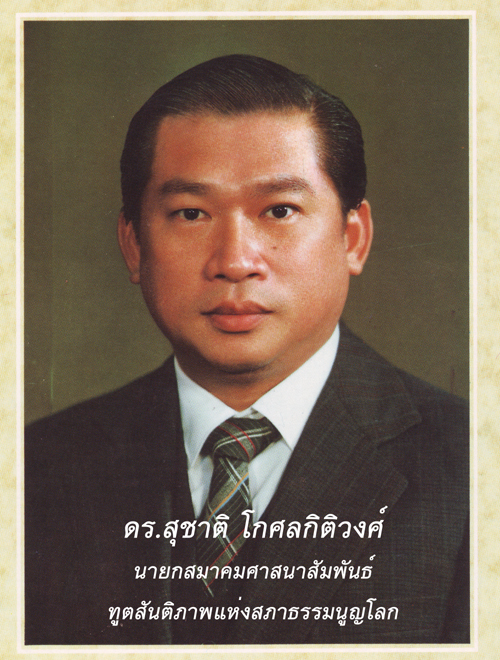
The Life and Work of the World Peace Envoy
Hon. Suchart Kosolkitiwong
BEGINNING
Born : Sunday 28th March 1943
Death : Saturday 28th December 1991
(Died as a layman and reborn as a monk)
Precepter : Phra Kru Dharmma-ratsunthorn
Act Announcing Teacher : Phra Palad Bhan
Ordination-Proclaiming Teacher : Phra Kru A. Sorrabhanya Prakart
Place of Ordination : Wat Mai Cherng-nern, Chonburi Province
Buddhist Monastic Name : Ariyawanso Bhikkhu
Deceased : Friday 7th January 2005
Age : 62 years
Years of Ordination : 13 years
Layman’s Name and Surname : Dr. Suchart Kosolkitiwong
Father’s name : Mr. Tecksue Sae Chua
Mother’s name : Mrs. Hui-huang Sae Lim
Siblings : 1. Mr. Kimyu Sae Chua (deceased)
2. Mr. Surin Kosolkitiwong
3. Mrs. Chariya Kosolkitiwong
4. Mrs. Pennabha Kosolkitiwong (deceased)
5. Mr. Suchart Kosolkitiwong
6. Mr. Sudharm Kosolkitiwong (deceased)
7. Mr. Sunai Kosolkitiwong
Place of Birth : Samphanthawong District, Bangkok, Thailand
FAMILY
The forefathers of Mr. Tecksue Sae Chua were noblemen in China. His birthplace was in Tia-ang district, Canton county, Kwangtung province, South China. Mr. Tecksue was a fellow college graduate with the former President Chiang Kai-shek. He served the government in the fourth highest position after President Chiang Kai-shek. He was a nationalist and a man of justice. In the great troubled times of China, the country was still full of corrupted government officials. Mr. Tecksue was in serious dispute with President Chiang Kai-shek and disagreed with the government’s style of administration. Upon learning that President Chiang Kai-shek had issued an order to kill him, he fled to Thailand in 1932. He then earned his living as a doctor of Chinese traditional medicine.
EARLY LIFE
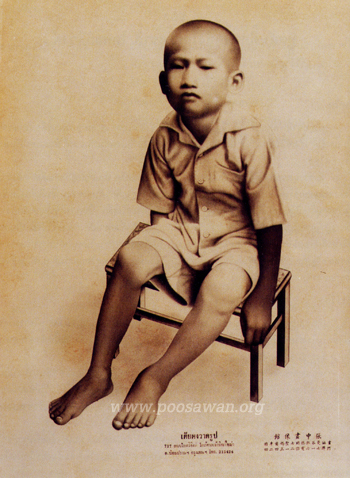
When Dr. Suchart was a young boy, he liked talking about the subject of Dhamma and rendering compassionate services to his fellow beings. He was not interested in learning in school but liked to learn more from others. After his father passed away when he was 9 years old, his mother had to work alone to raise her 7 children.
In his youth, the young Suchart liked playing under the Great King Rama I Memorial Bridge and swimming in the Chao Phraya River. Once, while swimming, he was seized by a cramp, unable to swim and sinking. Before he lost consciousness, he felt something lifting his body up, keeping his face and nose above water. His body floated along the river until a Chinese coffee seller’s boat passed by and rescued the boy Suchart from the water.
The memory of this incident of his miraculous survival remained strong in his mind. When Dr. Suchart was a grown-up and had to do public service, he firmly believed that the reason for him being alive was to render his services to others, therefore he did not die young.
When he was 10 years old, he stole 10 bahts from his mother and bought sweets for his friends. His mother found out about it and punished him by tying his right ankle with a piece of rope and attached the other end to the front door of the family’s house to humiliate him. From then on, young Suchart made a vow not to ask for any money from his mother. Thanks to her compassion, she sometimes left one or two bahts for him on his bed. On the days that he had no bus fare, he yielded to the necessity and took the money.
Since then, young Suchart did not go to school. He earned his own living getting paid for work: for example, serving noodles and coffee to patrons at footpath shops. Some nights, he returned home at one or two o’clock to find his mother still waiting up for him.
At the age of 14, he left home to work as an apprentice in trading shops. In the meantime, he continued his primary education at Wat Ratchaburana (Wat Lieb) School for Adults. He was able to not only pass but skip grades as well. After only two years of his studies, he completed grade IV primary education.
At the age of 17, he worked with Mr. Sahas Mahakoon at the Chinese Chamber of Commerce. During that period, a movie businessman brought a film to pledge for a loan. With young Suchart’s assistance, he met Mr. Sahas Mahakoon and the loan was granted. As a token of thanks, that man gave young Suchart an amulet of a Buddhist monk named Luang Poo Tuad (Changing Salty into Fresh Water), which was widely regarded as sacred. After receiving it, he kept it without paying it much attention. Until one day, young Suchart had an urge to test the miracle of his amulet. He then went to see a Buddhist monk in a temple and asked him about the method of invoking the sacred force of the amulet. That monk advised young Suchart of the right procedure.
When he began the procedure as suggested, he felt a big ball of light flying straight at his face which made him unconscious. After coming to his senses, his friends who witnessed the experiment told him that Phra Bodhisattva (a Would-be Buddha) Luang Poo Tuad came but he did not believe them. Afterwards he tested it again and again more than a hundred times until the Holy Spirit of Phra Bodhisattva Luang Poo Tuad really possessed young Suchart’s body and said, ”This man wants to test me, so I will take him on as my medium.”
START TO CURE SICK PEOPLE WITH HIS DIVINE POWER (1961-1964)
When the news spread out that the Supreme Spirit of Phra Bodhisattva Luang Poo Tuad used the body of young Suchart Kosolkitiwong as his medium, many sick people who suffered from all kinds of illnesses that were unable to be cured by doctors came to receive treatment from the divine power of Bodhisattva Luang Poo Tuad, through young Suchart. Many of them were thoroughly cured.
After a while, young Suchart was not willing to work for the Spiritual World so he planned his escape and fled to Laos but the Holy Spirit of Phra Bodhisattva Luang Poo Tuad still followed him and possessed him as before. During that period, there were political problems between the two countries and people were forbidden to go across the border. Dr. Suchart then challenged the sacredness of Luang Poo Tuad that if he was really sacred, Luang Poo Tuad must help him to return safely to Thailand. He was then miraculously returned home. It was at that time that he reached the mandatory age to be drafted into the armed forces. and served in the army for one year and six months.
SERVING IN THE ARMY
Private Suchart was drafted on March 23rd, 1964 and served in the First Anti-aircraft Regiment. Firstly, he was trained to man the anti-aircraft guns for four months at Camp Thanarat, Pranburi District, Prachuapkirikhan Province. Then he was transferred to an anti-aircraft unit. The official transfer letter from the Commander of Thanarat Camp read in part “P.V. Suchart Kosolkitiwong is a very good private with wonderful brain. A rank of Lieutenant Corporal is fit for him.”
While being a soldier, P.V. Suchart was very diligent, disciplined, and obedient to orders of his Commander. Sometimes, he felt in him divine power from the Spiritual World. On one occasion, while listening to lecture, P.V. Suchart raised his hand for permission to speak in front of the class. With the permission, he then spoke about strategy which was a matter far beyond the knowledge of a private. This puzzled and surprised the audience. On a certain hot day, P.V. Suchart said that he would call for rain. He then went to sit in the open-air, prayed a hymn and it then rained.
PROPAGATION OF DHAMMA AND MORALITY
In 1972-1980:
Dr. Suchart led his missions to boost the morale of the soldiers and policemen stationed along the remote border to encourage their dedication for the cause of the nation and world peace. He made more than 30 trips.
1973-1981:
Upon invitations, he gave lectures on the nation’s and world’s situation, the Buddhist solutions to social problems etc. at many academic institutes of different levels, government agencies, seminars, country prisons and so on. He was invited to lecture about 140 times.
1977-1981:
He gave monthly interviews on peace and religion to the press, media, radio and television programmes many times.
He directed the composition of nearly 20 songs on morality and peace ideals to be recorded and presented to audiences.
1977-1981:
On the 19th of each month, he delivered his speech on morality and peace ideals and relayed important events of the world to those religious people of different faiths.
Dr. Suchart occasionally gave his lecture on Buddhist morality and peace ideals to those on tours to the Religious Land.
- To educate the general public on Dhamma and peace ideals as well as to urge their prompt awareness of the threat of war, he issued and published about 90 publications.
- Whenever he was on his religious mission abroad, he never failed to urge the people to be aware of the immediate threat of war and guide them to the way of permanent peace.
- On December 25th, 1977, he issued a declaration on “the World Peace Day.” An appeal for world peace was made to such prominent world figures as Heads of States and Heads of Governments, Kings, Presidents, Prime Ministers, Ambassadors and so on, urging them to live in peaceful unison.
- On April 9th, 1981, he issued the Peace Declaration and sent it to the Thai Government, warning them of the possible war that might bring an unmeasurable disaster to the people as well as urging them to change their minds from greed, hatred, delusion (the three evil causes of fighting among men), and campaigning for the nationwide prayer for world peace.
- While attending the Annual NGO/DPI Conference of the United Nations at the United Nations Headquarters in New York on September 10th, 1981, he urged mass prayer for the cause of human unity and world peace.